AI training for employees: what AI Act article 4 really requires, and how to prove it
Key takeaways
- AI Act article 4 has applied since 2 February 2025 to every organisation that deploys an AI system, including when employees use ChatGPT or Copilot for their work.
- Since the Digital Omnibus (July 2026), the duty is to take measures to develop AI literacy, no longer to guarantee a sufficient level. The obligation stays.
- Article 99 sets no fine dedicated to article 4: the real risk comes through a data protection inspection, a dispute or a customer audit.
- What holds up: an inventory of uses, a charter, role-based proportionate training, a named record, updates, employee representatives informed where required, and an owner.
- Short training inside the tool people already work in, with one attestation per person, is easier to prove than a day in a classroom.
The short answer. Yes, the AI Act requires organisations to build AI literacy in the people who use AI on their behalf. That is article 4, in application since 2 February 2025. Since the Digital Omnibus of July 2026, the requirement is to take measures to develop that literacy, no longer to guarantee a level. There is no fine dedicated to article 4, but you need to be able to show what was done: who was trained, on what, when, and under which rule.
Your teams already use ChatGPT, Copilot or Gemini. How many have learned to use them without pasting a client contract in? That is exactly the question article 4 asks you to answer.
Who does article 4 apply to? #
Article 4 covers providers and deployers of AI systems. A deployer is an organisation that uses an AI system in the course of its business. A company rolling out Microsoft 365 Copilot or an internal assistant, or letting its teams use ChatGPT for work, is in that position.
The obligation covers staff and other people who use those systems on the company's behalf: temporary workers, contractors, freelancers working in your tools.
There is no size threshold. A 20-person company is in scope as soon as it uses AI. What changes with size is proportion: what is expected of an SME is not what is expected of a 5,000-person group.
What did the Digital Omnibus change? #
Regulation (EU) 2026/1744, the Digital Omnibus on AI, entered into force on 27 July 2026. It changed the wording of article 4. The duty is no longer to ensure a sufficient level of AI literacy, but to take measures to foster its development. The Commission and Member States, for their part, are to support organisations with practical examples.
The obligation remains. The level of proof expected has dropped.
One claim that circulates widely is wrong: the fine of 15 million euros or 3% of turnover for article 4. Article 99 does not list article 4. The real risk lies elsewhere: a data protection inspection after confidential data was pasted into an AI tool, a dispute in which you are asked what you had put in place, or a customer who asks the question in a security questionnaire or a supplier audit.
What do you need to be able to show? #
Seven pieces of evidence are enough for most organisations. None of them needs a heavy project.
- An inventory of uses. Which AI tools, used by which teams, for what. One page is enough, if it is current.
- A usage charter. What is allowed, what is not, what never goes into a public AI. Short, readable, known to everyone.
- Role-based, proportionate training. Not everyone needs the same thing: see below.
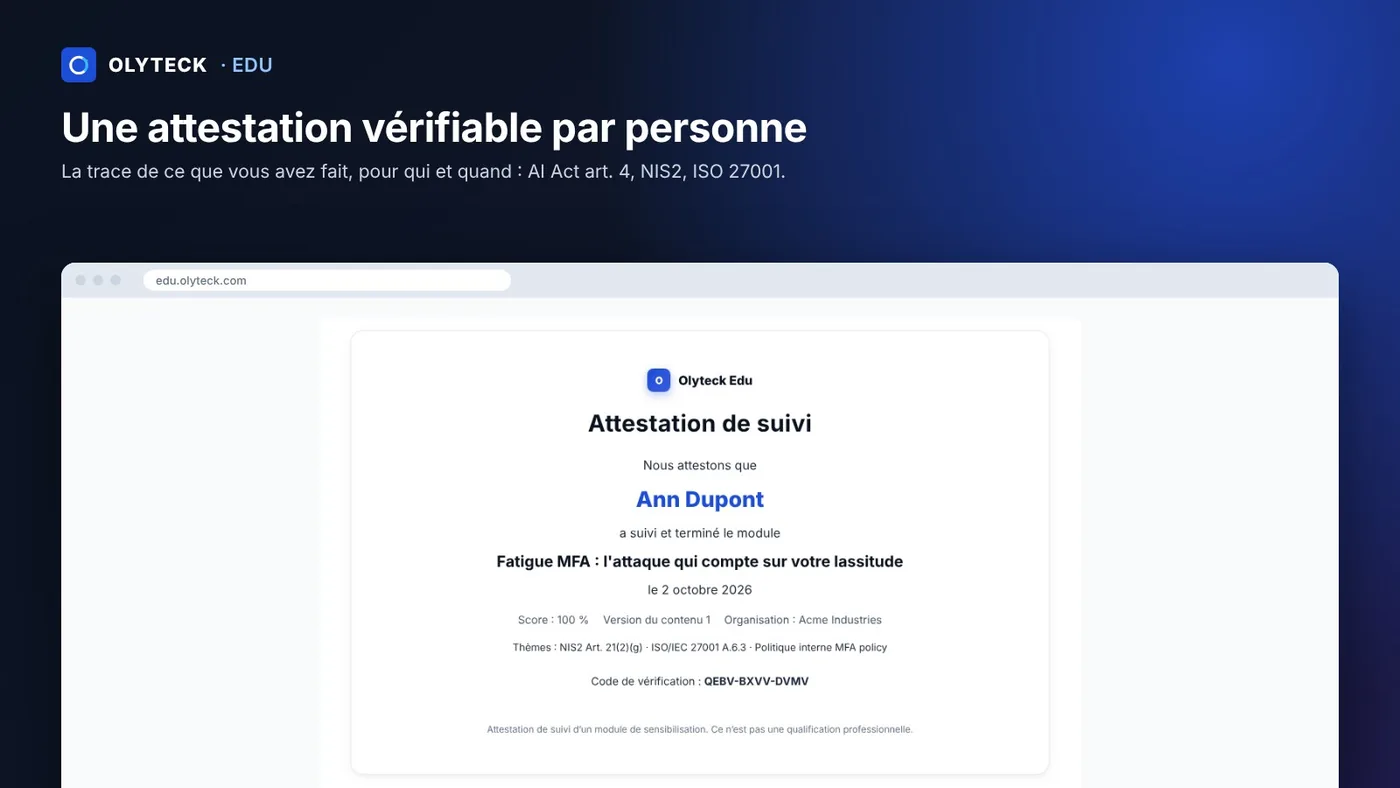
- A named record. Who completed what, when, on which version of the content. This is the proof most often missing: a lost attendance sheet proves nothing.
- Updates. A new tool, a new use, a new joiner: training follows.
- Employee representatives, where national law requires it. In France, for example, the works council (CSE) must be consulted before a new technology is introduced in companies with 50 or more employees, pilots included.
- An owner. One person who holds it together, often the CIO, CISO, DPO or HR.
What does proportionate training look like? #
Article 4 asks you to take into account people's knowledge, experience and context. In practice, three levels cover most organisations.
| Who | What they need to know | Format |
|---|---|---|
| Everyone | Check what the AI states, put nothing confidential into it, recognise a deepfake, know what the assistant can see | 30 to 40 minutes, in short modules |
| Managers, HR, legal | Prohibited or sensitive uses, decisions that stay human, employee consultation | One extra dedicated session |
| Advanced users, developers | Agents, the access you give them, AI-generated code | A technical track |
The first level matters most, because it reaches everyone, and it is the one most often missed, because a day of training for 200 people never gets scheduled. "Know what the assistant can see" is not theory: Copilot answers with everything the person can open, as the questions that quietly expose Microsoft 365 data show.
The last level matters more every month. When an employee installs a free tool coded with AI or connects an agent to their files, the question is no longer only "what do they type?", but "what did they give it access to?".
How to do it in one week #
A simple plan that produces the seven pieces of evidence without stopping the business:
- Monday: the inventory. Ask each department head which AI tools their team uses. Expect surprises.
- Tuesday: the charter. Start from a template, adapt it in 30 minutes, get it approved.
- Wednesday: the launch. Short training, sent where people work (Teams rather than one more email), with an end date.
- Thursday: the reminder. Automatic, to those who have not started.
- Friday: the proof. Export who completed what, and keep the export with the charter.
What we offer #
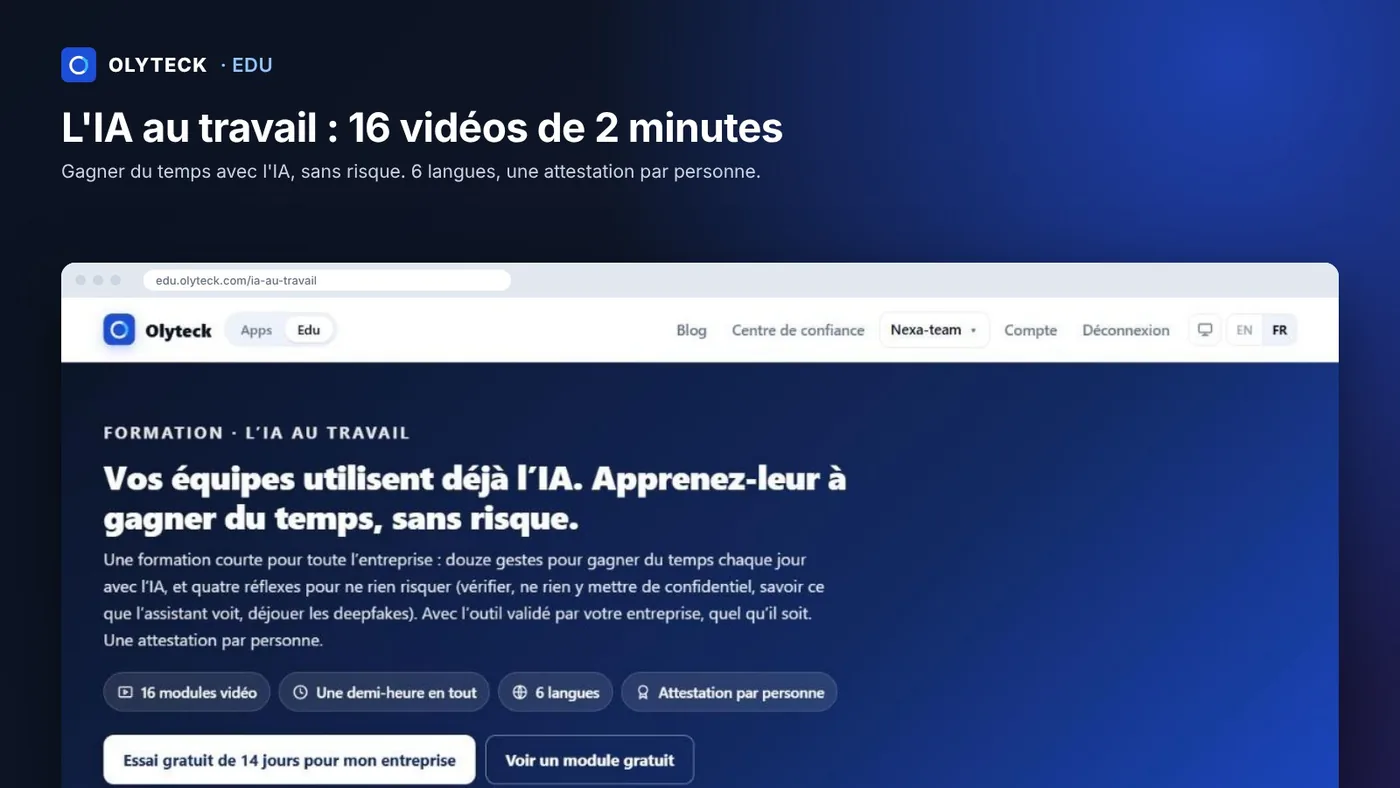
We built "AI at work" for that first level: 16 videos of 2 to 3 minutes, about 40 minutes in total. Write a clear request, let the AI ask the questions, question a long document, leave a meeting with decisions, check what it states, put nothing confidential into it, know what Copilot sees, defeat a deepfake.
- In Microsoft Teams (a "My training" tab, automatic reminders) or in the browser.
- In English, French, German, Dutch, Spanish and Italian: each person takes it in their own language.
- One attestation per person, with a public verification code, and an export per campaign: what was assigned, completion date, score.
- The first two modules are free.
Until 31 December 2026, ten companies can take the whole course for free, up to 50 people each: details on the course page.
FAQ #
Is there a fine for not training employees on AI? #
No dedicated fine: article 99 of the AI Act does not list article 4. The risk comes through other routes: a data protection inspection after a leak through an AI tool, a dispute, or a customer asking for proof in a supplier audit.
Is a one-hour ChatGPT training enough? #
It can be enough for the first level if it covers the risks, not just the tips: checking answers, keeping confidential data out, knowing what the tool sees. You also need the named record, and an update when the tools change.
Do temporary workers and contractors need training? #
Yes, if they use AI systems on the company's behalf. Article 4 covers staff and other people who use those systems in your name.
Is a training attestation a certification? #
No. An attestation proves that a person completed a piece of content on a given date. It is the record article 4 makes useful, not a professional qualification.
Read next #
- Where does your AI tool send your data? A due-diligence checklist
- Copilot prompt hacking: the questions that quietly expose Microsoft 365 data
- ArtCraft and PdfCraft, the free Adobe clones coded with AI: 3 questions
One useful Microsoft 365 email a month
New guides, findings from real tenants, and the occasional checklist. No sales sequence, unsubscribe in one click.